My Coworker Built a Marketplace on Replit. I Ended Up Rebuilding It.
A coworker built a manufacturing marketplace on Replit. The AI code looked like an app but fell apart underneath. Here is how we rebuilt it right.

So I get a message from an old coworker I haven't heard from in like a year and a half.
We used to work together at the same company. He moved on, I moved on, life happened. Then out of nowhere he hits me up.
"Hey man, so I've been building this marketplace app on Replit. It's for manufacturers. I got a lot of it done already but some stuff isn't working right. The page redirects are broken, the roles between manufacturers and buyers are all messed up, and I need separate dashboards for each user type. Can you jump in and help me clean it up?"
The classic "just fix a few things" message. Every developer has gotten one of these.
I said sure, let me take a look.
What I Actually Found
He wasn't lying. He did have something built. Replit's AI had generated pages, forms, a database, some basic flows. It looked like an app. You could click around and it genuinely felt like progress.
Then I looked under the hood.
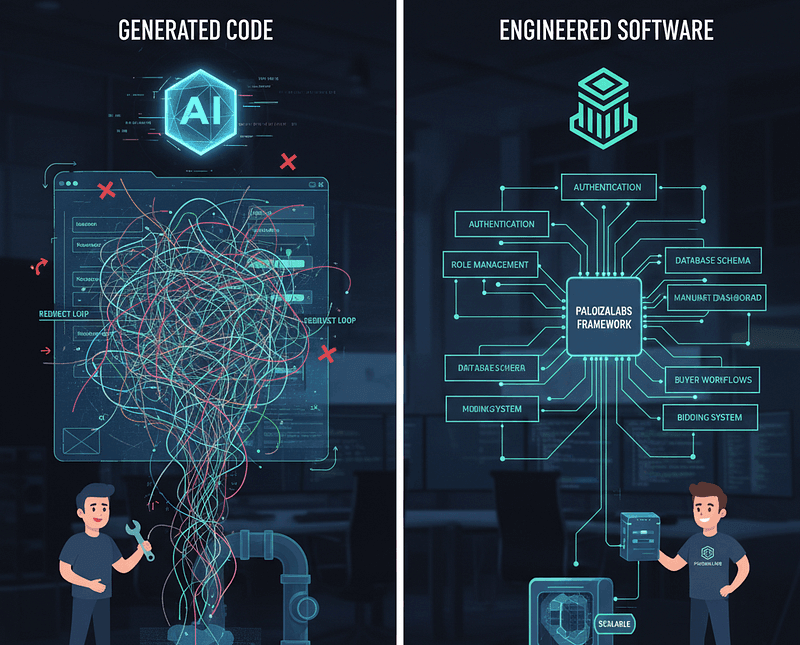
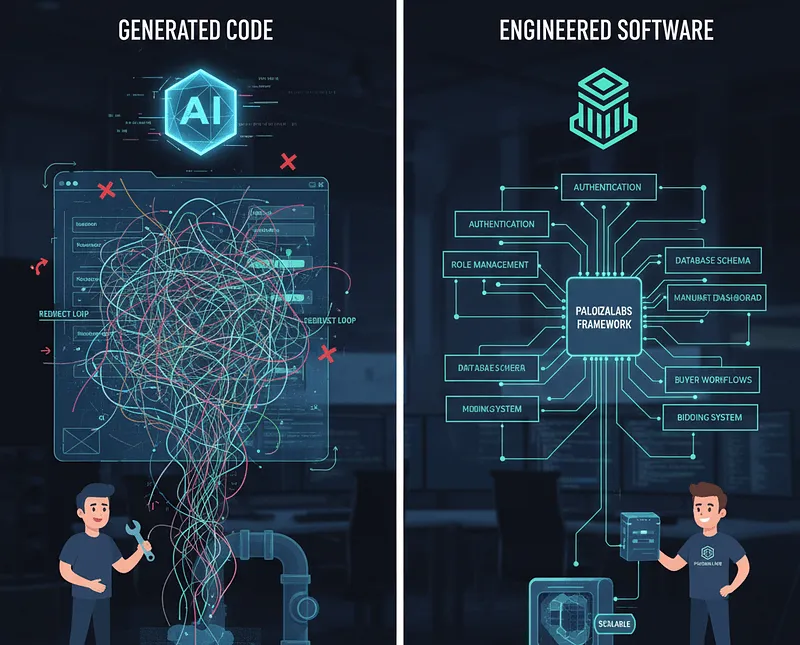
The role management was barely functional. Manufacturers and buyers were hitting the same views with no separation. There was no real access control. A buyer could literally see manufacturer admin features if they just knew where to navigate. Page redirections were looping or dropping users on screens they had no business being on.
Authentication was half baked. The kind where it works fine when you're the only one testing it but completely falls apart the second two different user types try to log in at the same time.
The database had no clear relational structure. Data that should have been connected wasn't. Queries were scattered everywhere with no pattern or consistency.
And this wasn't some simple todo app. This was a manufacturing marketplace. Manufacturers listing their capabilities, buyers submitting jobs, a bidding system, quoting workflows, file uploads for specs and technical drawings, progress tracking through production stages. Real business logic that needs to actually work.
The "Just Fix It" Problem
Here's the thing nobody tells you about AI generated code. It's not designed to be fixed.
It's generated. It doesn't follow an architecture. There's no module separation. There's no consistent pattern for how authentication is handled versus how data flows versus how the frontend talks to the backend. Every feature is kind of duct taped to the next one.
I wanted to help him so I spent about two hours just trying to understand the codebase. Not building. Not fixing. Just reading and trying to figure out what the AI was thinking.
That's when I told him the truth.
"I can patch this thing or we can do it right. If I try to fix what's here, I'm going to spend more time fighting the existing code than actually building features. And every time you want to add something new it's going to be the same story."
He didn't love hearing that. But he asked me what "doing it right" looked like.
Talk to an engineer
Building something like this?
Skip the sales call. Tell a senior engineer what you want to build and get a straight answer on scope and cost.
What Doing It Right Looks Like
I run PaloozaLabs. We build custom software on an architecture that we've been refining across dozens of projects. Authentication, role management, payments, email notifications, file storage, admin panels. All of that is already engineered, tested, and maintained in our core system.
So when a project like this comes in, we don't start from zero. The foundation is already there. My job and the job of AI working alongside me is to build the stuff that's actually unique to this client's business. The marketplace logic, the bidding system, the manufacturer dashboards, the buyer workflows.
That's the difference. Replit's AI tried to build everything from scratch with no context about how these pieces should fit together. Our setup already has those common problems solved so we can focus entirely on what makes this app different.
I told him here's what we'll do. I'll set up the project on our architecture, wire up proper role based access for manufacturers and buyers, give each one their own dashboard and permissions, set up the database the right way with real relationships, and then build out the marketplace features on top of that.
He said let's do it.
One Month Later
Within a month we had the first full draft of the workflows running. And I'm not talking about an MVP that looks like a homework assignment. The app had proper authentication with real role separation, manufacturer dashboards with their own views and controls, buyer dashboards that were completely different, a bidding system, quoting, file uploads, progress tracking. All built on a real backend with a real database that we can actually scale.
The thing that surprised him the most was how clean it all felt compared to the Replit version. Everything just worked the way you'd expect. Click a button, go to the right page. Log in as a buyer, see buyer stuff. Log in as a manufacturer, see manufacturer stuff. Sounds basic but that's exactly what was broken before.
Why This Keeps Happening
I'm not here to bash Replit or any AI coding tool. They're genuinely impressive for what they do. If you want to prototype something fast or test an idea before committing real money, they're great for that.
But there's a pattern I keep seeing.
Someone uses an AI tool to build something. It works for the first 70%. Then they hit a wall. The last 30% is the hard part. That's where you need real authentication, real role management, real database design, real business logic. And that's where AI generated code starts to fall apart because it was never designed with that complexity in mind.
And here's the part that really matters. You don't own anything. The code has no architecture. There's no documentation. There's no consistency. When you eventually need a developer to take over (and you will), they're going to look at it and say the exact same thing I said. "We should probably rebuild this."
What You're Actually Paying For
When my old coworker was building on Replit he thought he was saving money. Free tool, AI does the work, no developer needed. I get it. That math makes sense on paper.
But he spent weeks going back and forth with the AI trying to fix things. Then he spent time reaching out to me to fix things. And if I had tried to patch the Replit code it would have been even more hours fighting generated spaghetti.
When clients work with PaloozaLabs they're not just paying for code. They're paying for an architecture that's been proven across real production apps. They're paying for code they fully own. Not code that lives on someone else's platform. They're paying for something that can actually scale when their business grows. And they're paying for predictability, because the common stuff is already solved so we can give real timelines on the custom stuff.
That's the difference between generating code and engineering software.
And honestly he's happy. That's what matters.
Thanks for reading.
We build custom software for startups and businesses. Behind every project is a core system with common features already built (auth, login, signup, payments, emails, user management) so we can focus entirely on what makes your product different. You own all the code. Ready to build? Let's talk.