Will AI Replace Software Developers?
The honest answer from working engineers: AI writes code faster but cannot own the hard parts. What changes, what does not, and where the value goes.

AI for sure helps write code faster, leading to faster prototypes and faster deliveries, but the real value is that developers don't need to spend much time now on low value work like authentication, authorization, permissions, payments and all the common features that every app needs but no one should be rebuilding from scratch.
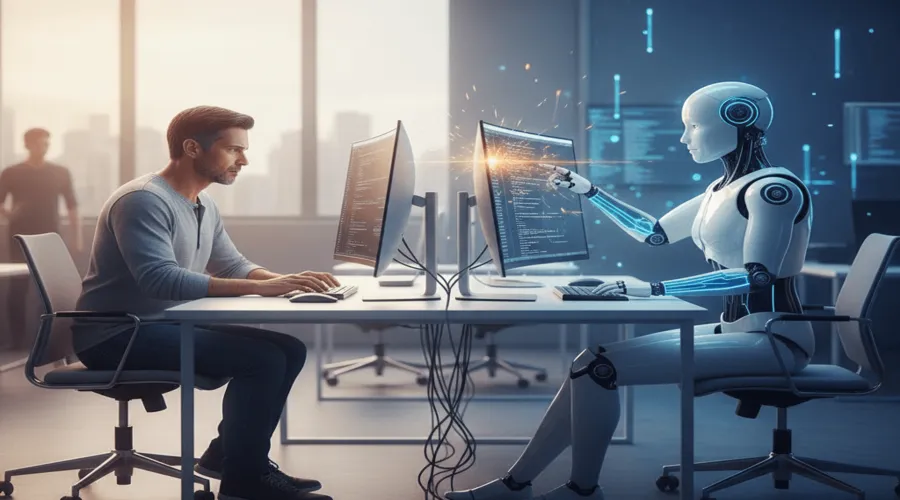
The real win is that developers can focus on what makes the software unique and have more time to understand the business model and the core problem they're actually solving. That's where the value is and not in writing another login flow, but in building the thing that makes your product different.
All the AI software building tools and vibe coding platforms are getting more people to build, which means more software out there, which means more work for software developers because at some point, everyone realizes they need a real software engineer.
From personal experience as a software engineer, I've had more work and built 10+ projects in the past two years. True founders and real businesses understand the value of an experienced software engineer who knows how to leverage AI.
Short answer
No, AI will not replace software developers, but it is changing the job. AI handles the repetitive 80% (auth, CRUD, boilerplate), so engineers who use it ship far more with far less. Expect fewer total roles and much harder junior entry, while experienced engineers who leverage AI, architect systems, and catch what AI gets wrong become more valuable, not less.
But Here Is Where It Gets Interesting
I posted this online and the responses were split right down the middle. Some people agreed, some people thought I was being naive, and honestly a lot of the pushback made good points worth addressing.
The Junior Developer Problem
One of the biggest concerns people raised is what happens to junior developers. If AI handles all the low value work like basic database frontends, CRUD operations, and simple integrations, then where do juniors get their experience? That is how they learn. If AI takes all the side quests then the low level characters cannot get experience and cannot level up.
And that creates a real problem down the road. If you do not grow juniors, you will not get seniors. So when the senior engineers retire or move on, there is no one qualified to replace them. Companies are making short term decisions that could bite them hard in a few years.
Right now, a lot of companies are cutting junior roles and having senior engineers use AI as leverage instead of managing a team of less experienced developers. That works today. But it is not sustainable if nobody is thinking about the pipeline.
Talk to an engineer
Building something like this?
Skip the sales call. Tell a senior engineer what you want to build and get a straight answer on scope and cost.
The Vibe Coding Security Problem
Another thing that came up a lot is security. AI in the hands of a junior developer can do reasonable security work. AI in the hands of a security professional can do awesome security work. But AI in the hands of someone who does not know what to ask or what to look for is basically useless from a security perspective.
You cannot just say make it secure and expect it to work. A lot of the coding platforms are trained on example code from docs and snippets from Stack Overflow, and none of that is especially useful for designing a secure system as a whole. There have already been real cases of this going wrong. Misconfigured databases, exposed API keys, the kind of stuff that happens when nobody actually understands what the code is doing.
This is actually why I think more people building with AI creates more demand for real engineers. Someone has to fix the mess or rebuild it properly when the business scales. AI lowered the barrier to build something but it raised the bar for building something good.
Want software built by real engineers who use AI as a tool, not a replacement? We build custom platforms on a proven architecture.
Teams Are Getting Smaller Though
I would be lying if I said AI is not reducing team sizes. People are reporting teams of 10 or 12 developers being reduced to 1 or 2. That is real. And it makes sense because if one senior engineer with AI tools can do the work that used to take a whole team, executives are going to cut headcount. That is just how financial markets work. The incentive is to reduce costs for shareholders.
Some businesses will choose to keep the same headcount and just get a lot more done. But I think most executives will go with option one and cut costs. That is going to create smaller organizations. We work with businesses and startups and we regularly deliver full SaaS platforms that would have required much larger teams a few years ago. AI plus a proven architecture means we can move faster and focus resources where they actually matter for the client. On the flip side, starting a business and being an entrepreneur is becoming easier and easier, which is actually a good thing.
It Does Not Need to Beat You to Replace You
There are a lot of papers coming out showing that the idea that AI is just going to keep improving forever is bad judgement. There are real scaling problems that could slow things down until we get to a new paradigm shift, and that could take years or even decades. But here is the counterpoint that I think is fair: AI does not have to keep improving forever to have a massive impact. It does not even have to be better than you to affect your career. If AI is 95% as good as a top developer and costs a fraction of the price, good luck asking for a raise.
The truth is probably somewhere in the middle. AI is here and it is a force multiplier. Multi agentic AI might be the next big leap but the infrastructure required to implement that at scale is still years out.
What I Actually Think
Look, I am not blind to what is happening. The job market for developers is tough right now. Companies are cutting roles and not replacing them. Computer science graduates have some of the highest unemployment rates they have had in a long time. Some of that is economic factors like tariffs and interest rates and post-COVID corrections. But some of it is genuinely AI reducing the need for headcount.
What I stand by is this: experienced software engineers who know how to leverage AI are more valuable than ever. The ones who understand the business, who can architect systems properly, who can review what AI produces and know when it is wrong. Those people are not going anywhere. Businesses and startups come to us because they want experienced engineers who know how to use AI to move fast, not a vibe coded product that falls apart at scale.
But will there be fewer developer jobs overall? Probably yes. Will junior roles get harder to find? Definitely yes. Will the role itself change? Absolutely.
AI is not going to replace all developers. But it is going to replace some of them, thin out the crowd, and completely change what it means to be a developer. The engineers who adapt and use AI as a tool to multiply their output will do great. The ones who ignore it or refuse to evolve are the ones who should be worried.
We build custom software for startups and businesses. Behind every project is a core system with common features already built (auth, login, signup, payments, emails, user management) so we can focus entirely on what makes your product different. You own all the code. Ready to build? Let's talk.
Read next. On the founder side of the same question, see can you build an app with ChatGPT.
Frequently Asked Questions
Will AI replace software developers?
No, not wholesale. AI automates the repetitive parts of coding, so it thins the crowd and reshapes the role rather than eliminating it. Engineers who use AI as leverage, understand the business, and can tell when AI is wrong are more in demand. More AI-built software also means more apps that later need a real engineer to fix or scale.
Will there be fewer software developer jobs because of AI?
Probably fewer total roles, and junior positions are getting harder to find as teams shrink from ten or twelve down to one or two seniors with AI tools. But demand for experienced engineers who can architect and review AI output is rising. The role changes more than it disappears.
Is AI safe to use for building production software?
Only in the right hands. AI used by someone who does not know what to check produces insecure systems: misconfigured databases, exposed API keys, and worse. AI paired with an experienced engineer who knows what to ask is powerful. That gap is exactly why more AI building creates more demand for real engineers.
Should I still learn to code if AI can write code?
Yes. AI raised the bar for building something good even as it lowered the bar for building something at all. Understanding how systems work lets you direct AI, catch its mistakes, and build things that hold up at scale. The engineers who pair real skill with AI are the ones who thrive.
Filed under