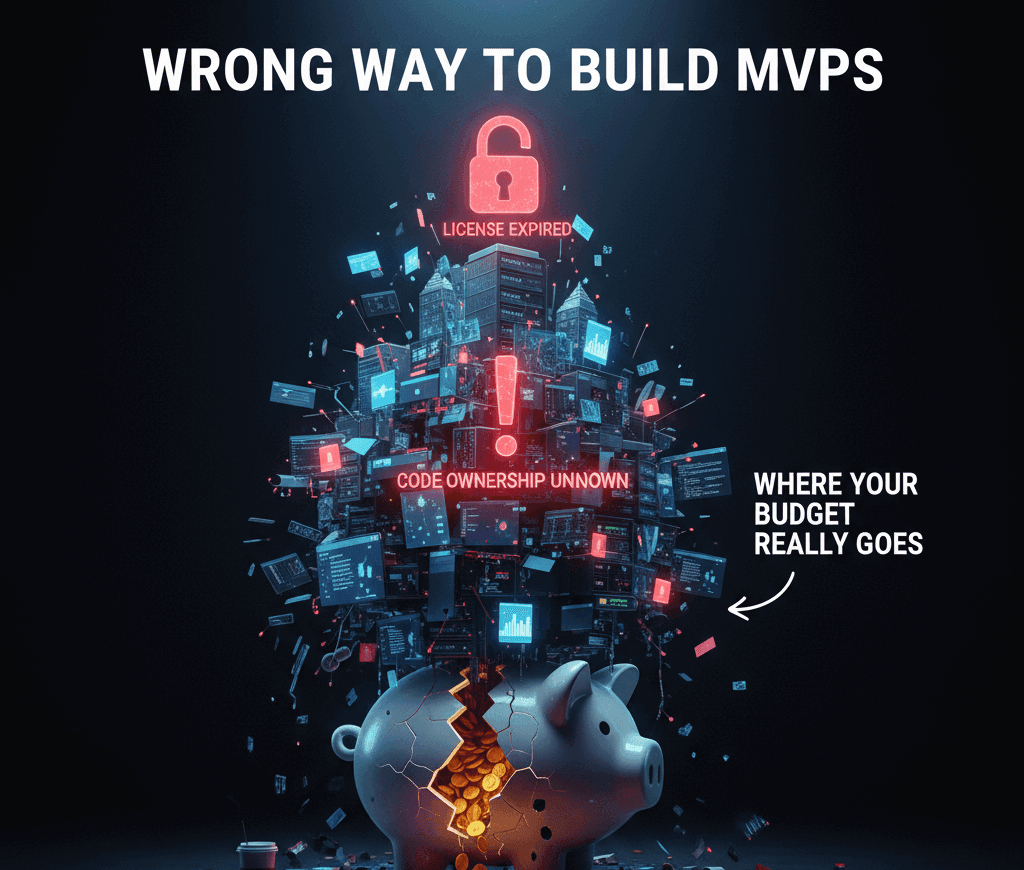
Stop Building MVPs The Wrong Way
Most founders blow half their budget on auth, payments, and plumbing every app already has, before touching the core feature. Here is the better way.

Most founders are told to start with an MVP. Validate the idea, keep it simple, ship fast, and I totally agree with that.
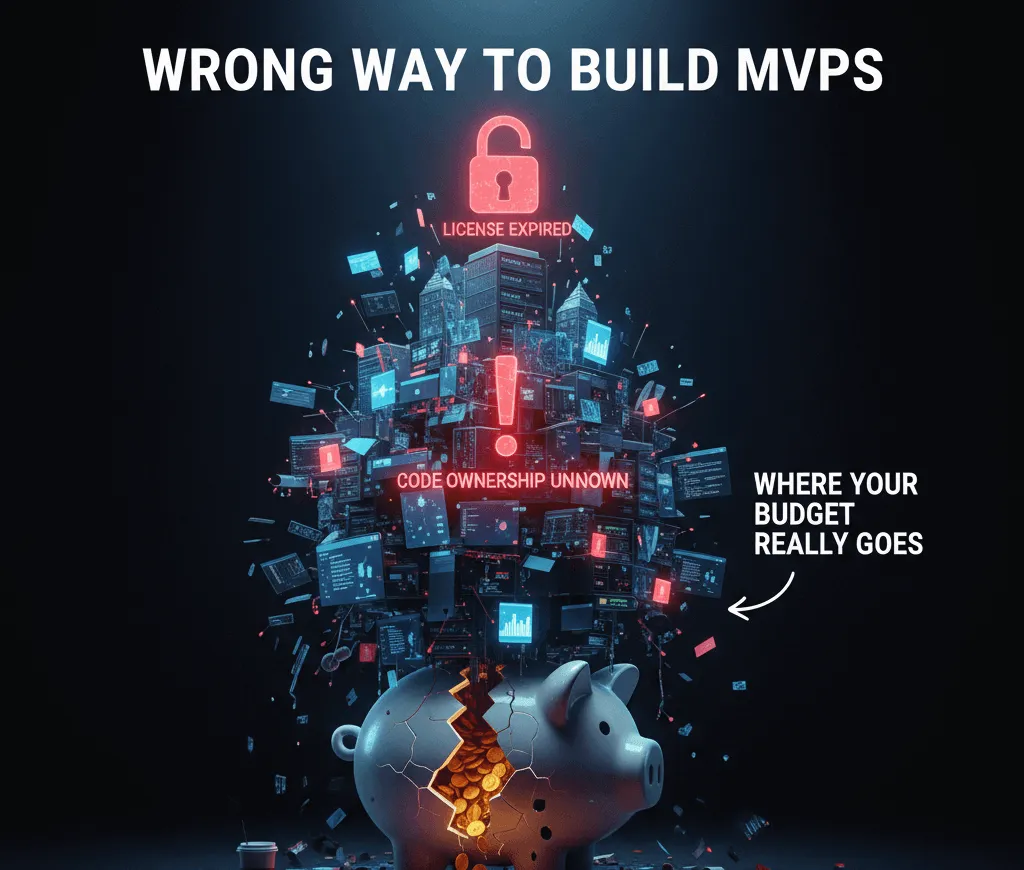
So they use no-code tools like Lovable or Replit, start prompting, and watch something get built right in front of their eyes. You end up with a nice MVP but you don't really own it, you know nothing about the code, and your budget goes into something that isn't yours. If you want to understand the real numbers, check out how much it actually costs to build an MVP in 2026.
Where Your Budget Really Goes
Most of the cost of building an app goes into the common stuff. Authentication, login, signup, forgot password, reset password, user management, role permissions, database setup, frontend to backend communication. Every app needs these. Every agency builds them from scratch and bills you for every hour. Every no-code tool makes you figure them out yourself while the clock and credits are running.
By the time you get to the feature that actually makes your product unique, half your budget and half your time is already gone.
The Alternative Approach
PaloozaLabs is a platform that works differently. All the common features are already built and you work directly with an engineer on a professional level.
Senior engineers developed and continuously refine a common software layer so you never have to pay for it again. On day one you get authentication, login, signup, forgot password, reset password, a connected database, and a working frontend to backend communication layer. All of it handled by an engineer, all of it yours and customizable. On day two the team starts working on what actually matters: your core features.
No prompting. No re-generating. No platform your product depends on to stay alive. A real engineer takes care the code and you own the code. No limitations and no subscription fees.
The budget goes where it actually makes a difference.
Talk to an engineer
Building something like this?
Skip the sales call. Tell a senior engineer what you want to build and get a straight answer on scope and cost.
What That Looks Like in Practice
MVP launched the correct way. Built on a scalable architecture from day one, not a prototype you will have to rebuild the moment real users show up. Unlike no-code tools or traditional agencies, you walk away owning every single line of code with no strings attached. You start with an MVP that can scale and is built on a solid foundation.
If you have an idea and want to build the real thing, PaloozaLabs is worth a conversation.
Build an MVP With No Customization Limits
Agencies charge over $10k for a basic MVP and no-code tools offer lifetime subscriptions over $1,000 yearly without ownership of your app. There is a better way: a platform where you benefit from pre-built, heavily tested modules for common features like subscription management, content management, shopping carts, payment gateway integrations, login/signup/password/reset, user roles, email gateway integrations, dashboards, and forms.
Instead of a subscription model, founders get full ownership of the code, tailored to their specific requirements with no customization limits. One client built core features and rapidly grew from an MVP to a full platform for less than $3.5k in record time. You also get a dashboard to track tasks, leave comments, control front-end features, and view real-time data like sign-ups and payments.
Best Way to Build a Web Application MVP in 2025
From a software engineer's perspective, now is the best time to hire an experienced engineer to build your app. With the assistance of AI, engineers can develop applications faster than ever, especially when they have pre-built modules. For example, an engineer with pre-built registration and login modules can quickly modify existing code to add custom fields and new calculations for a client's app using AI, then focus the remaining time on testing and quality.
AI also accelerates front-end UI and design work. Engineers can take a pre-built form, ask AI to add extra fields or rearrange them in a specific layout, and deliver polished interfaces faster. The result is a project started in weeks, not months, where you own the code with no customization limits and no subscription fees.
Steps to Build Your SaaS the Right Way
Whether you are building a small SaaS web-app with a single core feature or a complete MVP that can scale without boundaries, the process can be broken down into clear steps when you work with a dedicated software engineer.
Step 1: Generate your web project.
Kick start the project by generating an informative website from a single prompt or claiming a pre-built theme. This gives you a working foundation on day one.
Step 2: Edit and customize.
Use an intuitive editor to change colors, replace images, edit text, and add pages and navigation yourself. You can make these changes while the engineer works on backend tasks.
Step 3: Request engineering tasks.
Create tasks for custom features with no customization limits. Engineers convert tasks into quotes with one-time fees. You can chat with the engineer directly in the task detail page and pay a 40% initiation fee to start implementation.
Step 4: Scale at your own pace.
Custom tasks get implemented on top of the website you originally created. This process enables you to build an MVP task by task and scale at your own pace and budget. Discussing features and long-term goals with the engineer can also lead to discounted tasks when simpler solutions exist.
We build custom software for startups and businesses. Behind every project is a core system with common features already built (auth, login, signup, payments, emails, user management) so we can focus entirely on what makes your product different. You own all the code. Ready to build? Let's talk.
Frequently Asked Questions
What is the biggest mistake founders make when building an MVP?
Trying to build everything at once. The best MVPs focus on one core feature and prove it works before adding anything else.
Should I use no-code to build my MVP?
For quick validation it can work. But if you plan to scale or need custom logic, starting with real code on a proven architecture saves you from a full rebuild later.
How much should an MVP cost?
It depends entirely on what your core feature is. The key is putting your budget toward the thing that makes your product unique, not rebuilding infrastructure that already exists.
Filed under