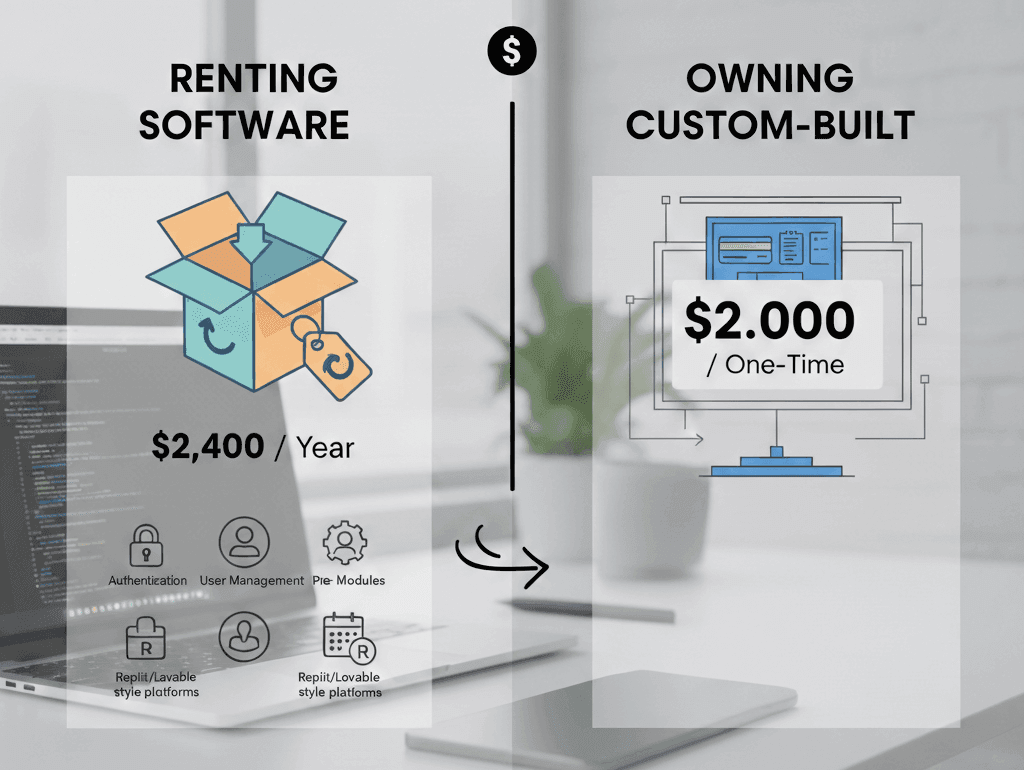
I Spent $2,400 on Lovable. Here's What I Actually Got.
I paid Lovable $2,400 a year before hiring developers. Real numbers on credits, rework, and code quality, plus a side by side cost table.

Hang on with me for a second and let's do the math.
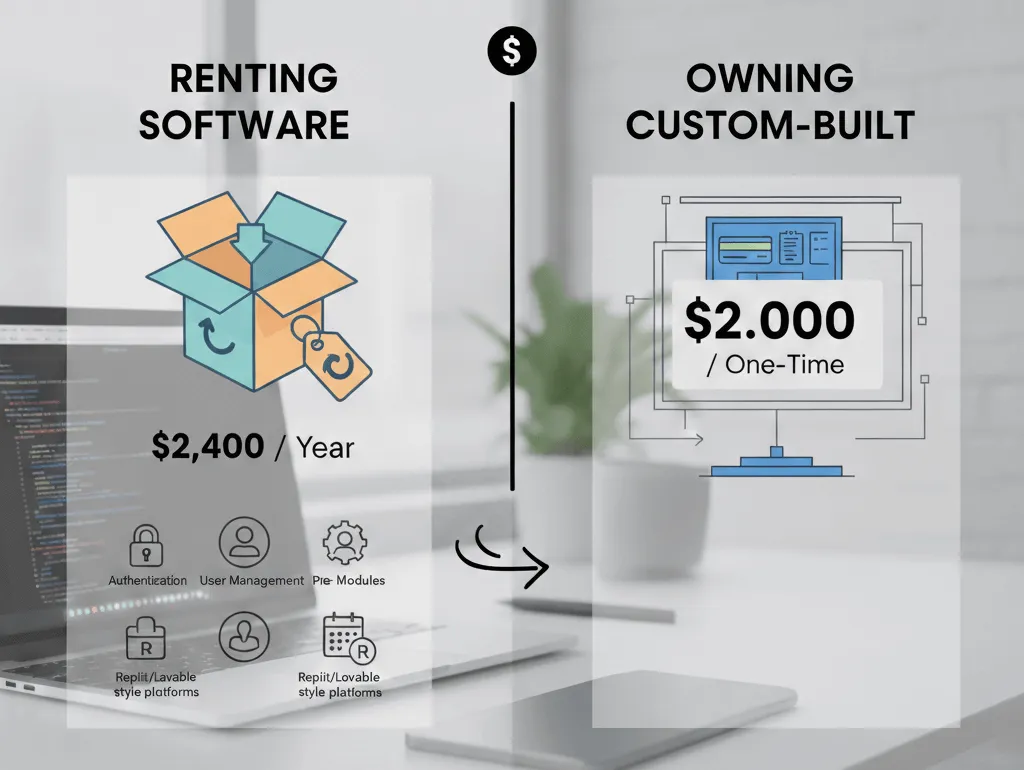
A serious builder on Lovable or Replit is looking at $100 a month minimum. Add extra credits and hosting and you are easily at $200 a month. Possibly more.
That is $2,400 a year. Every year. For software you do not own.
Short answer
Lovable runs about $2,400 a year and never stops billing. A one-time custom build of the same app is around $3,000, and you own the code, so the cost ends at launch. Lovable is cheaper for the first few months and more expensive by around month 14, once rework and credit overages are counted.
I get it. I really do. Seeing your app come to life in real time is addictive. No-code tools are great for validation and Lovable is genuinely impressive for that. But have you actually looked at how much it costs to build an MVP in 2026?
But here is what nobody talks about.
The 3 Walls Every Lovable User Hits
If you have been on Lovable for more than a couple of weeks, you already know the honeymoon ends. The first day is magic. By month two, you start noticing the same problems coming up over and over. These are the three walls that every serious Lovable user runs into. Not in theory. In practice. Every single time.
Wall 1: The feature Lovable can't build
You start with the easy stuff. Login. A dashboard. A signup form. It feels magical. Then you try to build the one thing your business actually needs. Maybe it is a multi-step approval workflow. Maybe it is a custom report that pulls from three different data sources. Maybe it is a webhook that has to talk to a CRM you have never heard of. And the AI just cannot do it.
You will burn through hundreds of credits trying. The AI writes code that looks right but does not run. It claims it fixed something it did not. You start noticing the same bug coming back two prompts after you "fixed" it. You are paying for the privilege of watching a machine fail at the thing you actually need.
This is the wall nobody warns you about. The 20% of features that make your app actually useful is the 20% Lovable cannot deliver. And by the time you hit it, you have already spent months building everything around that missing piece.
Wall 2: The scaling limit nobody warned you about
Let's say you got past Wall 1. You cobbled together something that mostly works. Now you start getting users. Real ones. Maybe 50, maybe 500. And things start slowing down.
Lovable apps are not optimized for performance. There is no proper database indexing. There is no caching strategy. There is no API layer designed to handle concurrent requests. The AI builds for "does this work in a demo," not "does this hold up under load." So the moment you have actual traffic, your app starts choking. Pages load slowly. Forms time out. Users churn before they even see what you built.
You cannot fix this from inside Lovable. You would need someone who actually understands backend architecture to rewrite the bones of your app. At which point, why were you on Lovable to begin with?
Wall 3: The export that isn't really an export
Here is the one that stings the most. You hit Wall 1 or Wall 2 and you decide it is time to migrate. You have heard you can "export" your code from Lovable. You can. Sort of.
What you get is a dump of files that technically run, but they were generated by AI with no architectural plan. There is no separation between business logic and UI. There is no API documentation. There are dependencies on platform-specific helpers that will not run anywhere else. Variable names are inconsistent. Error handling is missing in half the codebase.
Any developer you hire to take this over will tell you the same thing. It is faster to rebuild from scratch than to refactor what is there. So that "export" you have been counting on as your safety net? It is not really an exit. It is just proof that you spent $2,400 on something you cannot actually leave with.
Where Your Credits Actually Go
Most of your credits on Lovable go toward solving problems that are already solved. Registration. Login. Authentication. Authorization. Role management. User management. These features are not unique to your business. They are not what makes your product worth building.
An experienced engineer who has built real software before can stand up an entire app with all of those common features in a single day. Frontend designs can be generated with AI in minutes now. The real work, the real value, goes into the backend architecture, the database design, and the custom logic that is actually yours.
Talk to an engineer
Building something like this?
Skip the sales call. Tell a senior engineer what you want to build and get a straight answer on scope and cost.
What a Real Quote Looks Like
So let's say you are building a booking platform. Here is what a real quote might look like.
Booking Engine. Calendar-based scheduling where customers view real-time availability, select time slots, and book services. Conflict detection, cancellations, and rescheduling included. $950
Payment Integration. Stripe-powered checkout supporting one-time payments and subscriptions. Invoice generation, refund handling, and full transaction history. $850
Notification System. Automated emails and SMS at key moments. Booking confirmations, appointment reminders, cancellation updates. $600
Admin Dashboard. A private portal to manage all bookings, track revenue, and get a full overview of business activity. $600
Total: $3,000
And included at zero extra cost: user registration, login, authentication, authorization, role management, and password recovery. Pre-built, battle-tested, and ready to go.
Lovable vs Hiring a Developer: Side by Side
| Factor | Lovable / No-Code | Custom Developer (PaloozaLabs) |
|---|---|---|
| Annual Cost | $2,400+/year (recurring) | One-time payment per feature |
| Code Ownership | Platform-locked | 100% yours |
| Scalability | Hits walls at ~60% | Built to scale from day one |
| Architecture | AI-generated, no structure | Proven, battle-tested backend |
| Auth, Payments, Users | Burns credits on solved problems | Pre-built, included at no extra cost |
| Support | AI troubleshooting | Dedicated software engineer |
| Best For | Quick validation prototypes | Production-ready, scalable software |
The Choice
$2,400 a year to rent software you do not own. Or $3,000 once to own something scalable built specifically for your business.
Which one are you picking?
If you are past validation and ready to build the real thing, check out PaloozaLabs and let us know what you are working on.
Thinking about moving beyond Lovable to custom-built software? We build on a proven architecture with full code ownership.
Lovable vs PaloozaLabs: Building SaaS Apps
If you have a brilliant app idea but do not know how to code, the question is not just about getting it built. You want to understand how your app works and learn coding along the way. Lovable and PaloozaLabs approach this dual challenge very differently.
With Lovable, you describe what you want in plain English and the AI generates a working prototype. You can see the code, but understanding it is a different story. It is like being shown the engine of a car without knowing what the parts do. Small changes can unexpectedly break other features, and without coding knowledge, fixing these issues becomes trial and error. There is no software engineer to explain concepts as you encounter them.
With PaloozaLabs, you work directly with a software engineer who builds your app feature by feature. PaloozaLabs engineers have prebuilt tested modules for common functionalities like user authentication, dashboard layouts, payment processing, and database connections. These modules dramatically speed up development while maintaining quality. Instead of throwing you into the deep end, you get guided problem-solving, contextual learning, and a dedicated engineer focused on your project.
The pricing models reflect the difference. Lovable charges $29 to $99+ per month with hidden costs from troubleshooting and rework. PaloozaLabs offers a flexible feature-by-feature pricing model. You can start with basics like authentication and a simple dashboard, then add more complex features only when you are ready. You pay for one task at a time without committing to a large upfront amount.
Lovable Raised $650M, What That Means for You
Lovable closed a $330M Series B at a $6.6 billion valuation. Nvidia, Salesforce, Atlassian, and HubSpot all threw money in. That is $650 million raised in a single year. 100,000 new projects built on Lovable every day. $200M in annual recurring revenue. The numbers are insane.
But here is the thing. Vibe coding tools get you to 60% fast. Then you try to add payments, role-based permissions, or anything that requires two database tables to talk to each other properly and suddenly you are stuck. The AI starts looping. It "fixes" a bug, breaks something else, "fixes" that, and reintroduces the first bug. You are burning credits watching a machine go in circles.
A Reddit user put it bluntly: "It's great to spin up a project. But terrible once the project grows. Too expensive, and it's easy to get lost in the changes it makes, sometimes breaking other stuff."
The code Lovable generates is optimized for speed of creation, not for running a business. There is no proper separation of concerns. No clean API layer. No database optimization. No error handling strategy. No test coverage. Even authentication, one of the most basic requirements, is described by multiple reviewers as the most credit-expensive and error-prone feature on the platform.
$650 million in funding does not fix your app's architecture. Only good engineering does.
The Best Alternative to Lovable for Scalable Web Apps
Lovable has real advantages for rapid prototyping. No coding required, real-time preview, GitHub integration, and one-click deployment. But it comes with subscription lock-in, customization constraints, platform dependency, and challenges with complex logic.
PaloozaLabs offers a different model. You start by building an informative website on your own and then submit custom task requests through a professional dashboard. You communicate directly with Palooza engineers who understand both your vision and technical requirements. You get full code ownership with no recurring fees, unlimited customization, and the ability to scale without being forced into higher pricing tiers.
In today's AI-enhanced development environment, professional developers using AI tools can build custom applications faster than ever, making custom development competitive with no-code platforms. What makes the PaloozaLabs approach unique is the ability to start small and grow incrementally, paying for one task at a time with no big upfront commitment.
We build custom software for startups and businesses. Behind every project is a core system with common features already built (auth, login, signup, payments, emails, user management) so we can focus entirely on what makes your product different. You own all the code. Ready to build? Let's talk.
If you are looking at Lovable specifically to build a SaaS, see what goes into proper custom SaaS development, including the multi-tenant core that Lovable cannot actually handle at scale.
Read next. The same math for Replit is in Replit vs hiring a developer, and if you are ready to leave a platform, how to migrate off Bubble or Lovable walks through it step by step.
Frequently Asked Questions
Is Lovable cheaper than hiring a developer?
For the first few months, yes. Lovable runs about $200 a month with no upfront cost, while a one-time custom build starts around $3,000. But the subscription never stops, so by around month 14 the recurring fees plus rework overtake the one-time build, and you still do not own the code.
What are the disadvantages of Lovable compared to hiring developers?
Three main ones. It stalls on complex features and custom integrations, it is not built to scale past light traffic, and the code export is rarely usable, so you cannot cleanly leave. Rescuing a Lovable app with a developer afterward typically costs $2,500 to $6,000, on top of the credits you already spent.
Should I use Lovable or hire a developer for my startup?
Use Lovable to validate an idea or demo it to users in a weekend. Hire a developer once you need real users, payments, custom logic, or code you own. If you are past validation, a $3,000 one-time build usually beats $2,400 a year in subscription with nothing to own at the end.
What happens when Lovable can't build the feature I need?
You usually find out the hard way after you have already burned through credits trying. The AI keeps generating code that looks like it should work but does not, and it tends to break other parts of your app while it is at it. Most people end up either dropping the feature, hacking together a fragile workaround, or hiring a developer to build the missing piece outside the platform. None of those are great options once you are already invested.
Can I export my Lovable app and keep building it somewhere else?
Technically yes, but in practice the export is rarely usable as is. The code Lovable generates is built by AI without a long-term architecture in mind, so you get something that runs but has no real structure to build on. Any developer you bring in to take it over will probably tell you it is faster to rebuild from scratch than to clean up what is there. The export exists, but it is not the safety net it sounds like.
What is the ROI of Lovable versus hiring a developer?
Over 12 months, Lovable costs about $2,400 in subscription plus credit overages and rework, and leaves you with code you cannot fully own or scale. A one-time build near $3,000 costs nothing after launch and is an asset you own. The break-even lands around month 14, and everything after that favors owning the code.
Filed under