How to Build an App as a Non-Technical Founder Without Getting Burned
Five ways a non-technical founder can get an app built in 2026: no-code, AI builders, freelancers, agencies, or a lab. Real prices and when each fails.

If you are a non-technical founder in 2026, you have more ways to get an app built than at any point in history, and most of them are traps for exactly the reason they are attractive. They are cheap to start. This is every route I know, what each one really costs, and the one question that tells you which to take.

I am a software engineer, so you should read this knowing where I sit. But I have also been the person on the other end of the phone for a lot of founders who picked wrong, and the pattern is consistent enough that I would rather you hear it now than in month four.
Short answer
A non-technical founder has five ways to get an app built in 2026: a no-code platform ($29 to $349 a month), an AI builder like Lovable, Replit, or ChatGPT ($25 to $200 a month), a freelancer ($2,000 to $15,000), an agency ($15,000 to $50,000 and up), or a lab that builds on pre-built modules ($3,000 to $6,000 one time, code included). The first two are the right way to validate and the wrong place to run a business. The deciding question is whether strangers will pay you. If yes, build the blueprint with AI, then have it built once on a core you own.
The question that decides everything
Before the options, the question. Is this a business or an experiment?
An experiment is something you are building to find out whether anyone wants it. A business is something strangers will pay for, with their own data in it, that has to work on a Tuesday when you are not watching. The right route for an experiment is cheap and fast and disposable. The right route for a business is one where the parts that break, the database, the permissions, the payments, the security, were built by someone who has built them before.
Almost every expensive mistake I see is a founder using an experiment tool to run a business, because the tool was so good at the experiment that it felt like it would keep going. It does not. It stops at about 60%, every time, and I have written about that wall more than once because it is the most common call we get.
The five routes, honestly
1. A no-code platform (Bubble, Webflow, and friends)
Cost: Bubble runs $29 a month on Starter and climbs to $119 and $349 as your app uses more workload units. Good for: internal tools, simple directories, an experiment you have weeks to learn the platform for. Where it fails: performance as data grows, cost as users grow, and the exit. Bubble has no code export. Every hour you invest is an hour invested in staying. I laid out the full picture in no-code vs custom build in 2026.
2. An AI builder (Lovable, Replit, Bolt, ChatGPT)
Cost: $20 to $25 a month to start, and $100 to $200 a month once you are building daily and the credits or checkpoints add up. Good for: the fastest possible prototype. A clickable version of your idea in an afternoon, which is genuinely the best money in software if you are still validating. Where it fails: roles and permissions, any feature that needs two tables to cooperate, payments beyond a basic checkout, and security. The AI loops, each attempt costs money, and you cannot tell which attempt was closest. The honest 2026 verdict is in can you vibe code a full app in 2026, and the ChatGPT-specific version is in can you build an app with ChatGPT.
3. A freelancer
Cost: anywhere from $2,000 to $15,000 for a first version, depending on where they are, how experienced they are, and how well you scoped it. Good for: a well defined build when you have found someone good and can verify their past work. Where it fails: variance. The best freelancers are excellent and the worst will hand you something that a second developer refuses to touch. The two risks that actually hurt are ownership, if the contract does not say the code is yours it may not be, and the bus factor, since one person who gets busy or disappears takes your app's only map with them. Everything to check before you sign is in what to know before hiring a web or app developer.
4. An agency
Cost: $15,000 to $50,000 for an MVP is normal, and six figures is not unusual. Good for: funded companies that need a team, a project manager, and a design department on one invoice. Where it fails: the price, and what the price is buying. A large share of an agency quote is rebuilding authentication, payments, user management, and hosting from scratch for the hundredth time, plus the overhead of the people managing the people doing it. I broke down where that money goes in 80% of your software budget is wasted on what already exists.
5. A lab that builds on pre-built modules
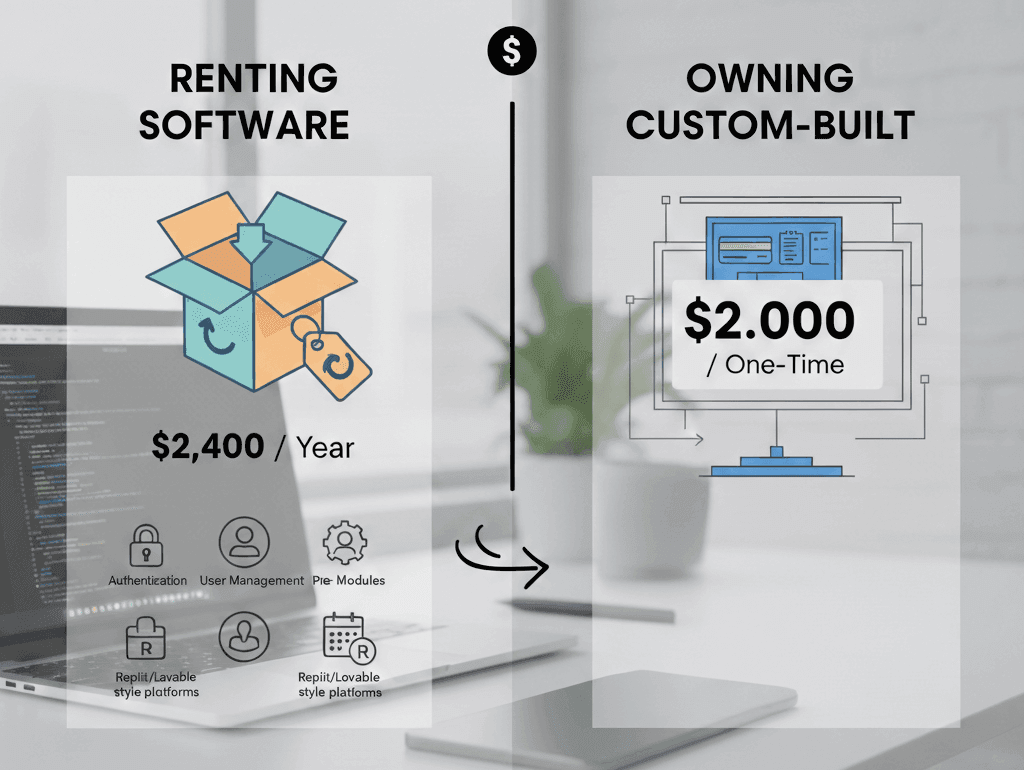
Cost: $3,000 to $6,000 one time for a first version, quoted per feature before work starts. Good for: a business, meaning strangers will pay you, that has passed validation and needs the real thing built once. How it works: the common parts every app needs, registration, login, password recovery, roles, payments, email, and user management, are already engineered and running in production across other platforms, so they are included instead of billed. Your budget goes entirely to the features that are yours, the engineer uses AI the way you would except they can read what it produces, and you own the code at the end. This is what we do at PaloozaLabs, and the full flow from free scope to launch is on our process page. I am obviously not neutral here. I am telling you the model because it is the one I built after watching the other four fail people.
Non-technical founder with a validated idea? Tell a senior engineer what you want to build and get a per-feature quote, with auth, payments, and user management already included.
Talk to an engineer
Building something like this?
Skip the sales call. Tell a senior engineer what you want to build and get a straight answer on scope and cost.
A note on the technical cofounder
People will tell you to find a technical cofounder. Sometimes that is right. But be honest about the price: it is usually 10 to 50% of the company, it takes months to find someone good, and the good ones have options. Giving away a third of your business to get a login page built is a bad trade in 2026, when a login page is a solved problem. Find a cofounder because you want a partner, not because you need code.
The four things to know before you pay anyone
Whichever route you take past the experiment stage, these four questions protect you. I have watched founders skip each one and pay for it.
Who owns the code? Get it in writing. Not "you can export it." Ownership, of every line, with the right to hand it to any other developer. On a platform, the answer is nobody. With a freelancer or agency, it is whatever the contract says. Read who owns your code before you sign anything.
Is the quote per feature or per month? A per-feature quote you can understand and compare. A day rate or a monthly retainer is a meter, and meters run. Ask what auth, payments, and user management cost, because if the answer is anything other than "included," you are paying to rebuild solved problems.
Can a second developer take over? If the only person who understands your app is the person who built it, you do not own an app. You own a dependency. Ask to see documentation from a past project, and ask what happens if they get busy.
What is the smallest version that proves the business? The right answer is usually auth plus one core feature. Not 50 features. Three to five that solve the actual problem. Everything after that should be paid for by revenue from the first version. I wrote about scoping that in what an MVP costs in 2026, and the classic mistakes are in hiring a developer for your startup.
The order that actually works
This is what I tell every non-technical founder who calls, and it is what the founders who end up with a business did, whether they meant to or not.
Validate with an AI builder. Spend $25 to $50 and a weekend getting a clickable demo. Put it in front of ten people who match your customer. If nobody cares, you just saved yourself $5,000 and six months. If they do, keep going.
Treat the demo as the blueprint, not the product. Every screen and flow you built is now the clearest specification an engineer has ever received. Do not try to push the demo into being the business. That is the 60% wall, and it costs more to climb than to walk around.
Build the real thing once, on a core. Auth, roles, payments, and user management already exist. Your $3,000 to $6,000 goes to the three to five features that make the product yours. It takes weeks, not months.
Own it. The code is yours, any developer can take over, and there is no monthly platform bill. Everything after launch is a feature at a time, paid for by the business the first version created.
If you already built on a platform and are past the point where this order helps, the way out is in how to migrate off Bubble or Lovable. And if you are weighing Replit specifically, the numbers are in Replit vs hiring a developer.
Where we work with founders
We are based in Los Angeles and work on Pacific time, so founders in Los Angeles, San Diego, and San Francisco get same-day answers and can meet in person when it helps. The lab was founded by an Australian engineer, and a large share of our work comes from founders and businesses in Sydney, Melbourne, and Brisbane, run async through a project dashboard so the time difference never slows the build.
We build custom SaaS, web apps, and mobile apps for non-technical founders on a proven core, quoted per feature, with the code yours at the end. Start with a free scope.
Frequently Asked Questions
How can a non-technical founder build an app in 2026?
Validate with an AI builder for $25 to $50, treat that demo as the blueprint, then have the real product built once on a core where auth, roles, payments, and user management already exist. A first version with three to five real features costs $3,000 to $6,000 and you own the code. Do not try to turn the demo into the business.
Should I use a no-code builder or hire a developer for a simple app?
Use a no-code or AI builder if you are still finding out whether anyone wants it, or if it is a tool for your own team. Hire a developer once strangers will pay you, because that is when roles, payments, data, and security have to actually work. The cheapest path is usually both, in that order.
How much does it cost to build an app without a technical cofounder?
$25 to $200 a month on a no-code or AI platform, $2,000 to $15,000 with a freelancer, $15,000 to $50,000 and up with an agency, or $3,000 to $6,000 one time with a lab that builds on pre-built modules and includes the common features. A technical cofounder costs equity, usually 10 to 50%, plus months of searching.
Do I need a technical cofounder to start a software company?
Not in 2026. The parts a cofounder used to be needed for, auth, payments, user management, and hosting, are solved problems that an engineer with a proven core includes for free. Find a cofounder because you want a partner in the business, not because you need someone to build a login page in exchange for a third of the company.
What should a non-technical founder ask before hiring a developer?
Four things. Who owns the code, in writing. Whether the quote is per feature or a running meter. Whether a second developer could take over from the documentation. And what auth, payments, and user management cost, because the answer should be "included" rather than a line item for rebuilding solved problems.
What is the smallest app I should build first?
Authentication plus one core feature, then two or three more that solve the actual problem. Not 50 features. Everything beyond the first three to five should be paid for by revenue from the first version. That keeps a first build in the $3,000 to $6,000 range and gets it launched in weeks rather than months.