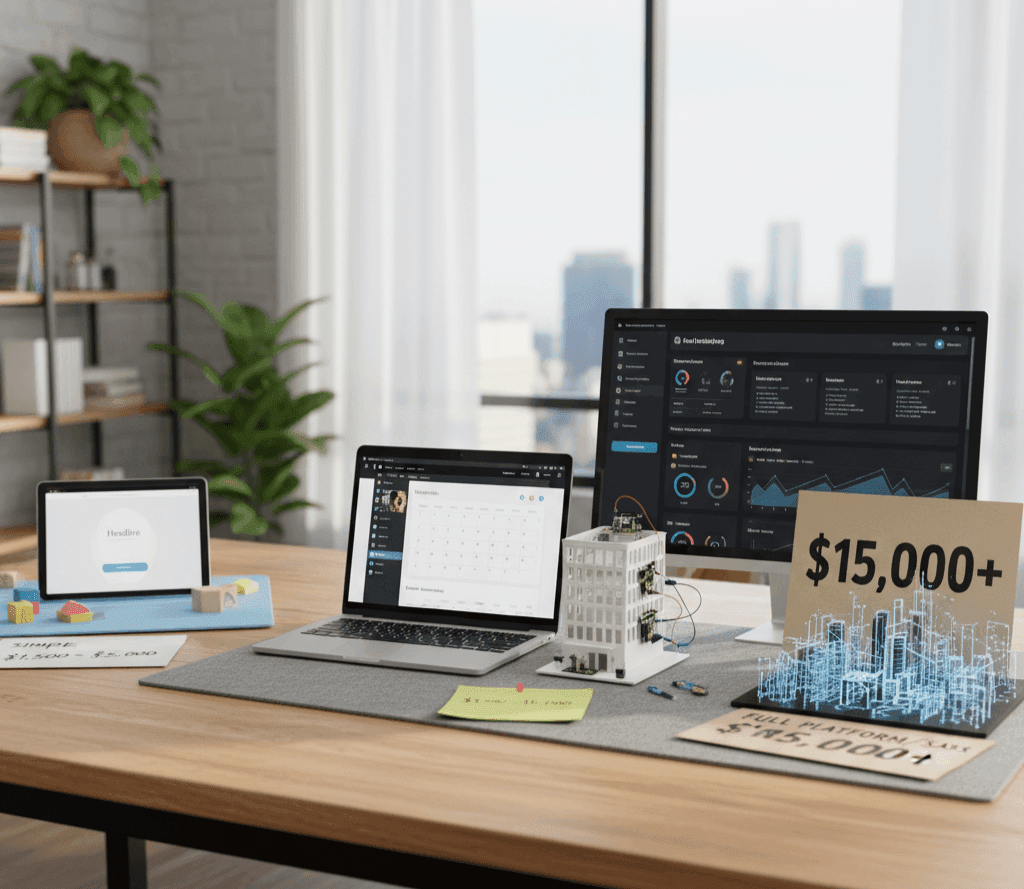
How Much Does a Website Cost in 2026? Real Numbers, No BS
Real website and web development costs from a developer who builds them. Landing pages from $500, SaaS platforms to $50K, and where agency markups hide.

If someone walked up to you and said "how much does a building cost" you would look at them like they're crazy. How many floors? Where? What materials? Is it a warehouse or a hotel? You cant answer that question without knowing what the building actually is.
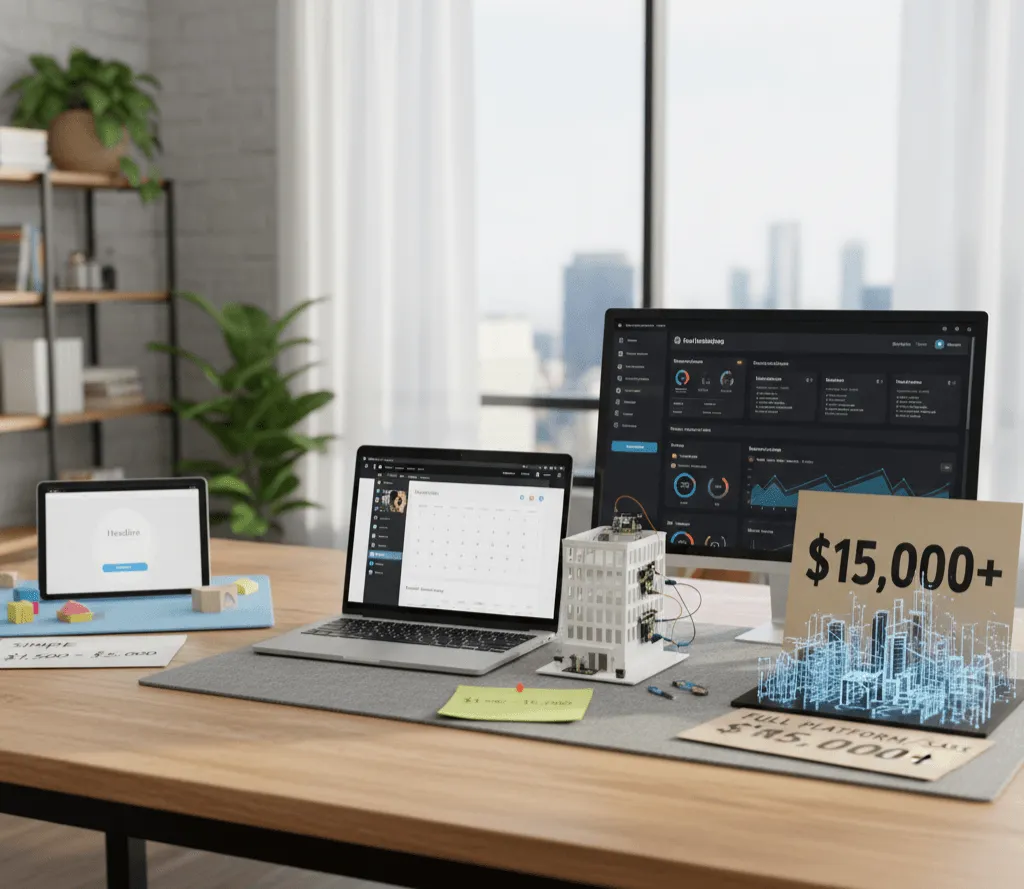
Websites are the same thing. But for some reason people expect a straight answer. They Google "how much does a website cost" hoping to find one number they can budget for and move on. It doesnt work like that and it never did.
I build custom websites and platforms for businesses. I have been doing this for years. The honest answer to "how much does a website cost" is it depends on what you need it to do. But I know thats not helpful on its own so let me actually break this down in a way that makes sense.
Short answer
In 2026, a simple informational website runs about $500 to $2,000. Add booking, user accounts, payments, or a dashboard and it is roughly $3,000 to $10,000. A full platform or SaaS product with subscriptions and integrations lands around $10,000 to $50,000 or more. On a reusable core the price drops, because your budget skips the login, payments, and admin every site needs.
A Website Is Not Just a Website Anymore
In 2026 a website could mean anything. It could be a simple landing page with five sections and a button. It could be a full booking platform where your clients schedule appointments, pay online, and get notifications. It could be a SaaS product with login, dashboards, subscriptions, and integrations with other tools.
These are completely different things. Asking how much does a website cost without explaining what you need is like calling a contractor and saying build me something. Build you what? A shed? A house? A skyscraper?
The reason nobody can give you a straight price is because nobody knows what you actually want until you tell them.
The Real Cost Ranges in 2026
Let me give you some real numbers based on what I actually see and charge. Not what some article sponsored by Wix or GoDaddy is going to tell you.
If you need a simple informational website with a few pages, some nice design, and a contact form you are looking at the lower end of the spectrum. This is a straightforward build. No login, no payments, no complex features. Just a clean site that makes your business look legit online.
If you need something with more functionality like a booking system, user accounts, payment processing, or some kind of dashboard the cost goes up significantly. This is where most small businesses land because they dont just want a website. They want a tool that actually does something for their business.
If you are building a full platform or SaaS product with subscriptions, admin panels, integrations, and custom workflows you are in a completely different category. This is software development not web design. The price reflects that because the complexity is completely different.
The cost will vary depending on who you hire, where they are, and how fast you need it. But if someone is quoting you almost nothing for a custom website with payments and user accounts in 2026 something is off.
Talk to an engineer
Building something like this?
Skip the sales call. Tell a senior engineer what you want to build and get a straight answer on scope and cost.
What AI Actually Changed About the Cost
Everyone wants to talk about AI so lets talk about it honestly. AI has changed the game but not in the way most people think.
AI did not make custom websites free. What AI did is make the boring repetitive parts faster. Setting up a basic layout. Generating placeholder content. Writing the repetitive code every project needs. Stuff that used to take hours now takes minutes.
For me as a developer this means I can build faster which means my clients pay less for the same quality. The time I used to spend on the stuff that every website needs like login pages, password resets, email notifications, payment integration, I have already built all of that into a base system that I reuse across projects. So when a new client comes in their budget goes straight toward the thing that makes their business unique. Not the stuff underneath that every website needs anyway.
AI tools like Lovable, Bolt, and Replit can get you a prototype fast. For some people thats enough. But the gap between a prototype and a production ready platform that real customers trust with their money is massive. Thats where the real cost lives. Not in generating the first version but in making it actually work reliably.
If you are a founder testing an idea and you just need something quick to validate it, AI tools might be all you need for now. But if you are running a business and you need something that scales, handles real users, and doesnt break when 50 people are using it at the same time, you are going to need someone who actually knows what they are doing.
The Hidden Costs Nobody Talks About
The website itself is not the only cost. This is where a lot of business owners get surprised.
Hosting. Your website needs to live somewhere. A simple site on shared hosting is cheap. A platform with a database, file storage, and background jobs is going to cost more. The range varies wildly depending on what you are running.
Domain. Your .com costs a small annual fee. Not a big deal but you need one.
Maintenance. Things break. Libraries get updated. Security patches come out. If nobody is maintaining your site it will slowly rot. Budget a few hundred dollars a year at minimum for someone to keep things running.
SSL. This used to cost money. Now its free with most hosting. If someone is charging you for an SSL certificate in 2026 RUN.
Content. Photos, copy, videos. A lot of people forget this part. You can have the best designed website in the world but if the photos are blurry and the text reads like a robot wrote it nobody is going to care.
Template vs Custom, the Real Conversation
This is where it gets interesting because in 2026 you have more options than ever.
You can use a website builder like Wix or Squarespace for a small monthly fee and have something live in a weekend. For some businesses thats genuinely the right move. If you are a local coffee shop and you just need your menu, hours, and location online, a template is fine. No shame in that.
But templates have a ceiling. The moment you need something specific to how your business works, something that no template was designed to do, you hit a wall. Then you are either forcing your business to fit the template or you are starting over with something custom.
I have had clients come to me after spending months fighting with a no code tool trying to make it do something it was never built to do. They thought they were saving money. They ended up spending more because now they are paying me to rebuild it plus they lost all that time.
The question isnt template or custom. The question is what does your business actually need right now and what will it need in six months. If the answer is simple and static, go template. If the answer is I need this thing to actually run a part of my business, go custom.
How I Work and Why It Costs Less Than You Think
I am going to be transparent because I think most developers are not. I work off a pre-built base that I have developed over years of building platforms. This base already includes user authentication, payment processing, email notifications, user management, and subscription handling. Its battle tested. Its secure. Its the same foundation I use on every project.
What this means for you is that when we start building your project we are not starting from zero. We are starting from a foundation that already handles all the common stuff. Your budget goes entirely toward the features that are unique to your business.
This is why I can build a full platform for a fraction of what most agencies charge. Not because the quality is lower. Because I am not rebuilding the wheel every single time.
So How Much Does Your Website Actually Cost
It costs exactly as much as the problem you are trying to solve. A landing page is a different problem than a booking platform. A booking platform is a different problem than a full SaaS product.
Figure out what you actually need. Not what you think sounds cool. Not what your competitor has. What does your business need right now to make money or save time.
Then talk to someone who builds these things. Get a real conversation going. Ask them how they work, what their process looks like, and what you get at the end. If they cant explain it simply they probably cant build it simply either.
If you want to talk through what you are building, DM me or check out paloozalabs.com. I build custom websites and platforms for startups and small businesses. No templates. You own the code. No limits on what we can build.
We build custom software for startups and businesses. Behind every project is a core system with common features already built (auth, login, signup, payments, emails, user management) so we can focus entirely on what makes your product different. You own all the code. Ready to build? Let's talk.
Frequently Asked Questions
How much does a website cost in 2026?
A simple informational site is about $500 to $2,000. Add bookings, accounts, payments, or a dashboard and it is roughly $3,000 to $10,000. A full platform or SaaS product runs $10,000 to $50,000 or more. The price tracks what the site has to do, not the page count.
How much does custom web development cost versus a website builder?
A builder like Wix or Squarespace is $15 to $50 a month and fine for a simple static site. Custom development is a larger one-time cost, but you own the code, have no feature ceiling, and pay no rising subscription. The break-even comes fast once you need anything a template was not built to do.
Why do website quotes vary so much?
Because a landing page, a booking platform, and a SaaS product are three different problems. Complexity, integrations, who builds it, and how fast you need it all move the number. A reusable core lowers it, since your budget skips the login, payments, and admin every site already needs.
What hidden costs come with a website?
Beyond the build: hosting (a few dollars to a few hundred a month depending on the app), a domain (a small annual fee), maintenance (budget a few hundred dollars a year for updates and security), and content like photos and copy. SSL is free in 2026, so do not pay for it.
Filed under